

Last week, we hosted a breakfast session at Understanding Data. And as you would expect, there were pastries on the table. Lots of pastries. During the session, we took a few pictures of the table. At first glance, they are just nice atmosphere shots. But in reality, those photos perfectly illustrate what a snapshot is in the world of data.
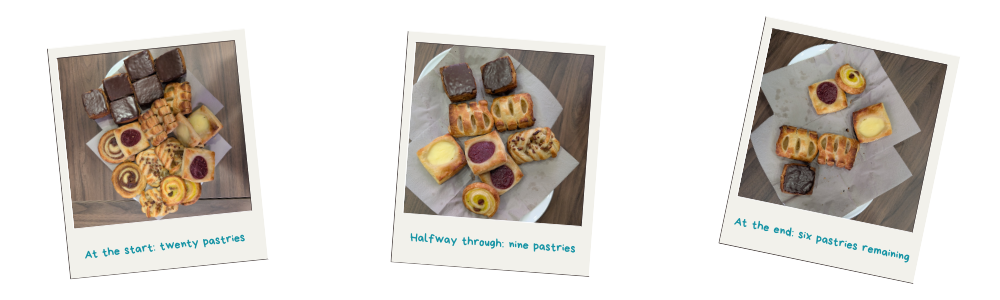
A snapshot is a capture of data at a specific moment in time.
Just like a photo shows how many pastries were on the table at 8:30 AM, a snapshot preserves what a dataset looked like at a certain point in time. It sounds simple, but it is incredibly valuable. Without snapshots, you only see the current situation, not how you got there.
Imagine we had only taken the last photo. We would know that six pastries were left, but we would have no idea:
Snapshots allow us to analyze evolution instead of only looking at static states.
Of course, the more snapshots you take, the more detail you capture. With just three photos, we can see the general flow of the breakfast session. If we had taken a picture every minute, we could have analyzed exactly when the raisin pastries disappeared and which pastries were the clear favorites.
Data works the same way. More snapshots provide deeper historical insight, but they also require more storage and processing power. The right frequency therefore depends on what you want to analyze.
Many systems constantly overwrite data.
A customer changes address? The old address disappears.
A product price increases? The previous price is replaced.
For operational processes, that is often perfectly fine. But for analytics, you lose important context. Snapshots solve this problem by regularly preserving the state of the data.
Time is often the missing dimension in reporting. A snapshot adds that dimension. Suddenly, you can answer questions like:
Time becomes a fully-fledged dimension in your data, which is essential for reliable reporting and analysis.
So far, we have explained snapshots using photos. But how does this actually work in a data system? In data warehousing, we use the concept of Slowly Changing Dimensions (SCD): techniques for handling changes in data over time.
In practice, there are two common approaches:
SCD Type 1 (overwriting)
The simplest approach is to simply overwrite the data. The newest value replaces the old one.
In our metaphor: you only look at the table as it is right now. You see what is left, but not what was there before.
This approach is suitable for operational systems where only the current state matters.
SCD Type 2 (preserving history)
Another option is to keep track of every change. Instead of overwriting the existing data, you add a new version.
The old value is closed with an end date, and a new record is created with a start date. This makes it possible to reconstruct the full evolution of the data and see exactly what something looked like at a specific point in time.
In our metaphor: you keep every photo you take, so you can later see how the table evolved over time.
Snapshots may seem simple, but they are often the foundation of reliable analytics, trend detection, and historical insight.
And sometimes, that insight simply starts with a table full of pastries.
Curious how snapshots can strengthen your reporting or data platform? Contact us now.
Do you want to make better use of your data and information? Contact us now, and learn how we can bring your organisation to the next level.